The Attention Trap
On the dangers of trading in online traffic & celebrity
related articles
Size Matters
Scalable digital works require us to make decisions about size constantly, in real time.
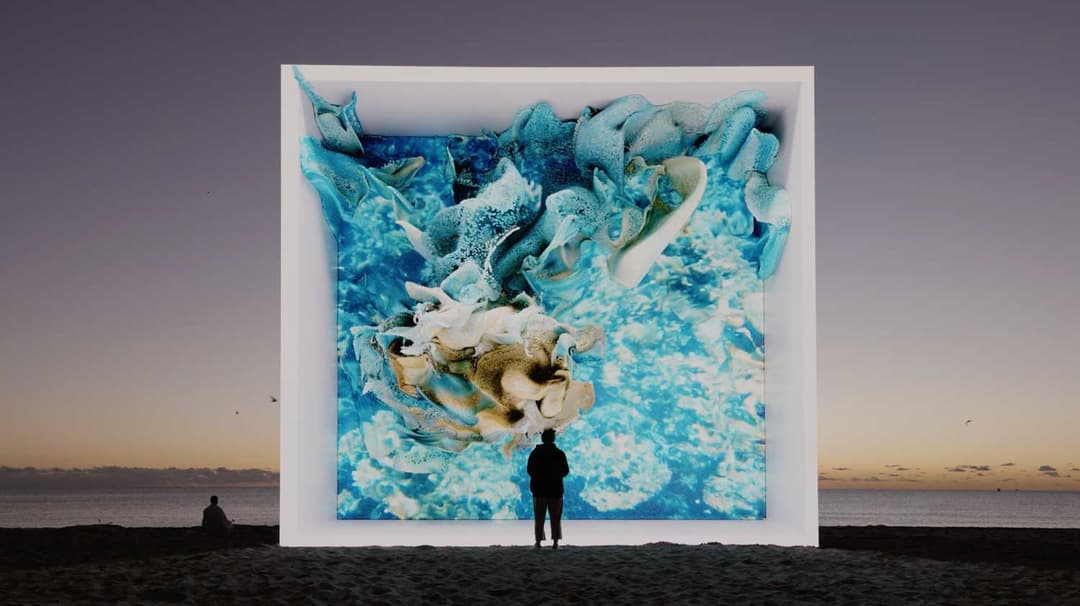
<p dir="ltr">When Refik Anadol unveiled Coral Dreams, a 10x10 meter gigantic screen installation at the Faena Hotel on South Beach, I had considered the news terribly gauche. In 2021, when everything was digital and groundbreaking and the first of its kind, cynicism was not hard to come by. In the case of this beach-takeover, I genuinely struggled to understand the insistence on presenting a video in an outdoor context that in my mind should have been a screen-free zone.</p> <p>As the chaos of Art Basel week unfolded, I was unable to visit the installation during the day, and by the time I got to it, around 11:30 at night, the chaos surrounding it from a distance had given way to something much more interesting: a cluster of people, all quiet as though having signed some unspoken contract, witnessing Anadol’s Machine Hallucinations unfold, waves of visualised data occasionally giving way to images of the sea and corals.</p> <p>Whatever you may think of data visualisation, the work had a significantly different, and to me largely unexpected, impact at night. We sat down in front of it, nodding to a few strangers sitting in silence as though we had come into a drive through movie theater a few minutes too late. No one in our art cluster said a word, even though we had all expressed strong opinions of Anadol and digital art in the past. We were like moths to a flame, dwarfed by the colossal screen, and collectively we lost sense of time. The piece was accompanied by the acoustics of the ocean crashing onto the beach in slow, rhythmic pulses. It was surprisingly spiritual.</p> <p dir="ltr">Today, that piece, specifically as a beach installation, remains my favourite piece made by Anadol.</p> <p dir="ltr"><img src="https://storage.googleapis.com/taex-storage-prod/news/upload-3014644002.jpg" alt="Refik Anadol, Machine Hallucinations" width="1500" height="840"><br><span class="custom-span">Refik Anadol, Machine Hallucinations—Coral Dreams, 2021, Image: refikanadol.com</span></p> <p>In our quest to make digital art accessible and popular, one thing that the overabundance of smartphones has harmed is the context in which art gets experienced. The iPhone (or Android) screen form factor is perhaps the worst possible way to witness digital works of art, but due to its ubiquitousness, it has become the default. Unlike physical works, which are often photographed in their context, digital art is presented as a full screen (or full post) image, which means that it is consistently, and inescapably, a rectangle that fits the palm of your hand.</p> <p>But such a small and ephemeral presentation cannot rival a 10x10m megascreen. Granted, a colossal and 6-figure tech production is not in the budget for every artist and gallery. But intentionality in production, rather than literal size, is crucial.</p> <p>When we are browsing digital art on our phones, we have too much power over it. We can close it or switch apps without a thought, we can scroll past it, we might have the ungodly yellow "evening" filter on, which subverts any colour correcting the artist may have toiled over for weeks if not months to achieve. We might get a text that interrupts our experience. We might be tempted to look at how many people liked the piece, who commented on it, how many times it was viewed, all of which is information that the traditional art experience does not contain because museums mercifully do not have audience metrics displayed next to artworks.</p> <p>Have we lost some of the magic that comes with allowing the artist, rather than a tech giant, decide on the scale and context of how an artwork should be experienced?</p> <p>But more importantly, and perhaps more dangerously, a new generation of digital artists are being raised prioritising the cellular/gadget-centric experience of their practice with the misunderstanding that optimising output for social media may lead to greater virality and thus, some intangible form of success. This can be as simple as opting to shoot vertically, or worse, not caring about the size of the display screen for a future exhibition. </p> <p>I am here to tell you that the size at which you present your work, no matter how scalable it might be, matters. The dimensions and pixel density you choose, the colour profile you select (rather than what the owner or manufacturer of the screen may have selected for you) matters. Whether the blacks are presented via an LCD screen (where backlit blacks read as gray) or an OLED screen (where blacks are true black, but you cannot display static images due to pixel burn-in) matters. Similarly, you are entitled to refuse a certain type of monitor, or projector, or other digital manner of presentation. You are allowed to be a diva if not being one comes at the cost of having your work distorted in some manner. Being grateful that a space might give you screens at all gets us nowhere as a culture or an industry; especially if that space does not know the first thing about calibrating the screens or choosing one that can handle higher frame rates. Think of it like witnessing a painting’s brushstrokes versus not ever seeing them. It’s the difference between our ability to imagine the painter’s physical gestures, the choreography involved in creation, which can change your relationship to an artwork and a more neutered, removed experience where details are lost not because they don’t exist, but because they cannot be rendered due to available equipment.</p> <p dir="ltr"> </p> <p dir="ltr"><img src="https://storage.googleapis.com/taex-storage-prod/news/upload-1163399036.jpg" alt="Francesco D'Isa, Error" width="1500" height="1001"><br><span class="custom-span">Francesco D'Isa, Error, Installation view of Scoletta dell'Arte: Digital Reform, 2024</span></p> <p>Having a learned opinion on how a particular work of digital art should be experienced is largely missing from the discourse. The online marketplaces often do not allow for the presentation to have such intentionality, but I rarely see an NFT or a digital work come with a note that says “this work should be presented on such and such screen under such and such circumstances.”</p> <p>Paintings do not come with such instructions either, but that is largely because the painter has already decided on the size, and the laws of physics dictate how a flat canvas can be lit in most environments. There is less flexibility once an analogue artwork is complete, and thus, a lot of the intentions have to be set when the work is being made.</p> <p dir="ltr">Scalable digital works require us to make those decisions constantly, in real time. I have observed time and time again, online culture and the politics of respectability dictate how emerging digital artists end up actually emerging. This is often at the mercy of their tech sponsor who have a vested interest in showcasing their work using the latest 75-inch OLED TV display in a carpeted booth that screams “We’re really here to sell you this TV with art functionality, not the other way around.” It is an unholy alliance, one that the art world embraces because the right tech gear that can do digital art justice is still expensive.</p> <p>The commercial landscape for digital art is wildly complex, this is true, but the fact remains that digital artists and digital curators are not interior decorators. There is nothing worse than an artist or a curator who says “oh you can turn it off if you have guests over,” or “it can be any size you want.”</p> <p>Can you imagine someone saying you can turn off the statue of David?</p> <p dir="ltr">Context matters, your choices matter.</p> <p dir="ltr">Size matters.</p> <p> </p>

The Water Cost of Big Tech
Technology can be thirsty. Some tech more than others.
<h3 dir="ltr">As global warming continues to make summers unbearable, and New York City’s climate has recently been re-designated as "subtropical," the environmental impact of AI and the blockchain have once again become topics of discussion.</h3> <p dir="ltr">According to Alex de Vries, founder of the Bitcoin Energy Consumption Index, in 2021 the CO2 emissions of Bitcoin was 65,4 million tonnes, roughly the equivalent of a mid-sized European country. What wasn’t addressed as much in mainstream news was the water cost, which was 1.57 billion litres, which amounts to nearly 700 Olympic-sized swimming pools. Today, that number is 2.3 billion litres, and the total water consumption of cryptocurrencies that require proof-of-work, i.e. more computing, is 3.7 billion litres. Proof-of-stake chains like Ethereum are fundamentally less thirsty, but a single Bitcoin-based transaction consumes around 16,000 to 22,000 litres of water.</p> <p dir="ltr">In comparison, AI data centres around the world are consuming an estimated 560 billion litres of water per year, which is equivalent to roughly half the amount of water in Lake Annecy in France (so many, many more pools).While it is safe to say that compared to cryptocurrency, AI is the leading consumer of water, when it comes to individual transactions or processes, such as a single NFT sale versus a ChatGPT query, things are slightly different. </p> <p dir="ltr"><img src="https://storage.googleapis.com/taex-storage-prod/news/upload-1274305311.jpg" alt="Lake Annecy, golibo//Getty Images" width="1497" height="991"><br><span class="custom-span">Lake Annecy, Image: golibo, Getty Images</span></p> <p dir="ltr">A single AI query on ChatGPT consumes between 0,32 and 25 millilitres. Granted, we often use AI for an entire conversation, rather than a single question, but even if we were to multiply that number by 10, or 100, we would still be several orders of magnitude below the water consumption of blockchain transactions. You could think of it as a shot glass of water versus a swimming pool.</p> <p dir="ltr">This is a crucial difference, because it changes consumer culpability. A single person engaging in speculative trading for a week on the blockchain, will in all likelihood consume more water than one person having a philosophical debate with ChatGPT over the course of an entire year.</p> <p dir="ltr">And yet, we do not hold individual crypto traders and NFT holders in our lives nearly as accountable for their environmental impact as we do those who engage in/with AI.</p> <p dir="ltr">A surprisingly high number of people continue to flood my DMs with mentions of how much water is consumed every time someone makes a query with ChatGPT. As an artist working with AI, it has become one of the first criticisms people launch at me, even before they see the work. I certainly do not dismiss that AI, especially on a corporate level, can be a thirsty beast.</p> <p dir="ltr">But the art world has been a big water consumer for a long, long time. </p> <p dir="ltr">From collectors flying on private jets, to the cost of shipping artworks across continents; from the environmental impact of sourcing materials for producing sculptures, producing paint, developing film photographs etc., to erecting temporary exhibition spaces, there are many elements of the art world that require large quantities of water. The Venice Biennale might have achieved carbon neutrality in 2022, but CO2 emissions and water consumption are entirely different things. Still, lowering CO2 emissions includes managing logistics to be more efficient, which means it is reasonable to assume a positive impact on water consumption. But, even if an institution is environmentally-conscious, art world patrons are often luxury travelers with big environmental footprints.</p> <p dir="ltr">A private mid-sized jet flight consumes roughly 800 gallons of water for a two-hour flight, and there are nearly 10,000 private flights taken every day. Annually, this adds up to 15.3 billion litres. According to The Guardian, around 250,000 people fly private every year, and most are repeat fliers. This means that the average annual water cost per private jet user is about 61,200 litres. Broken down per flight, the water cost is roughly 4,286 litres.</p> <p dir="ltr">For example, in 2023, Kim Kardashian consumed approximately 707,000 litres across her 165 private flights as reported by Ashley Pomplas of The Post Athens, making her the single global leader in individual water consumption. To reach her level of water consumption, an individual would have to make 37 NFT transactions, or generate 55,9 million individual queries on ChatGPT, which, even at 1 query per second, is physically impossible. In other words, if you release an NFT collection with 40 artworks and you sell out, you have just spent as much water as a celebrity flying on a private jet nearly every other day.</p> <p dir="ltr">So now at least, we have a fascinating exchange rate for what our individual actions cost in terms of water.</p> <p dir="ltr">Of course, this is not a perfect comparison. In fact, there are countless other industries whose water consumption could be included in this article. But, in the messy, messy Venn diagram of art, technology, and luxury, private flights consume significantly more water than public AI tools like ChatGPT on an individual level.</p> <p dir="ltr">Now, when we zoom out, global data centers do consume significantly more water, around 4-6 trillion litres to be exact. This easily exceeds global aviation, at 40-60 billion litres. I am simply emphasising that hating on OpenAI and holding your friends accountable for global warming would have less impact than asking Kim Kardashian to fly commercial for a year.</p> <p dir="ltr">As the anti-AI sentiment continues to surge through social media, and people seek new scapegoats to blame for the excruciating heat waves passing through the Northern hemisphere, it is vital that we take a moment to ensure our outrage is not purely reactionary and ill-researched.</p> <p dir="ltr"><em>Important note: Most of the math in this article is very, very rough. I am not a statistician and I barely survived high school trigonometry, but the numbers are publicly available for anyone interested. I am more interested in fairness, accountability, and strongly welcome (even encourage) everyone to do their own research before hating on AI.</em></p> <p> </p>
Stay Tuned
Be the first to learn about new collections, events, and more.