Digital art: what to expect in 2025?
New formats, brave decisions and unexpected discoveries.
related articles
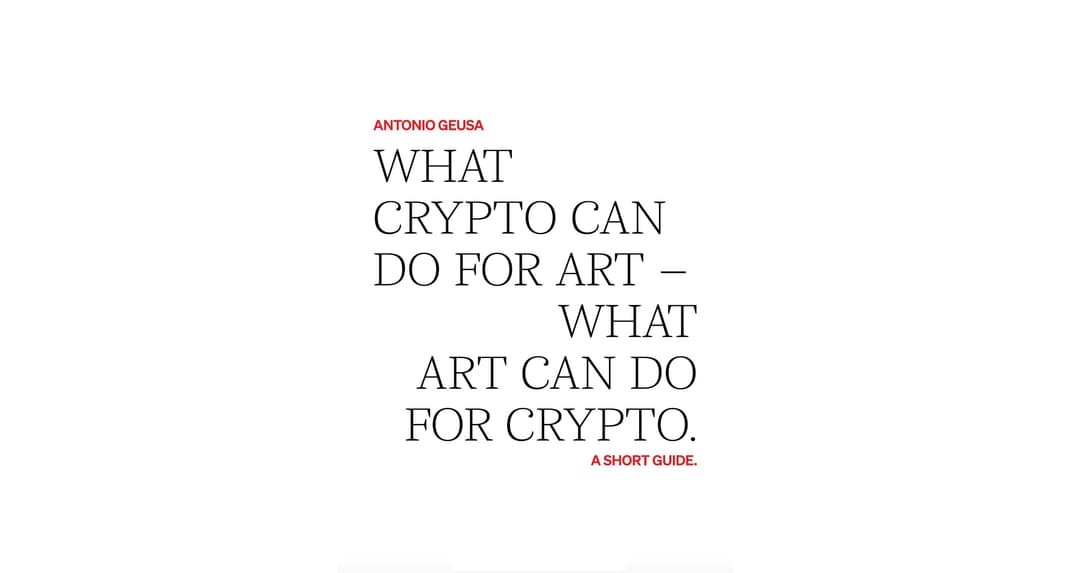
New book by Antonio Geusa is out now
What Crypto Can Do for Art — What Art Can Do for Crypto is available for free download
<h4 dir="ltr">We're delighted to announce the release of a guide written by TAEX curator Antonio Geusa titled What Crypto Can Do for Art — What Art Can Do for Crypto.</h4> <p dir="ltr"> </p> <p dir="ltr">It is designed for the art community that is curious about crypto input into the art field. At TAEX, we believe the art community requires not only navigation through the crypto universe but theoretical reflections and analysis of its potential development.</p> <p><strong> </strong></p> <p dir="ltr">Geusa starts by exploring the possible discoveries that can be brought by crypto into art. Then he offers a brief overview of NFT art and crypto art history in 10 artworks each. Then Geusa reflects on the reciprocal influence of art on the crypto world, by raising the financial, psychological, and institutional aspects. After the conclusion, Geusa points out the bullet points and provides to readers a room for further thoughts.</p> <h4><strong id="docs-internal-guid-0d2e4819-7fff-dfc3-05b5-4e0b10cb0680"><br></strong> You can download an electronic copy right away via <a title="Download new book by Antonio Geusa" href="https://drive.google.com/file/d/11YgUtGbw_B-N6VAc8cIB4BdzVtXN1ikT/view?usp=sharing" target="_blank" rel="noopener">the link.</a></h4>
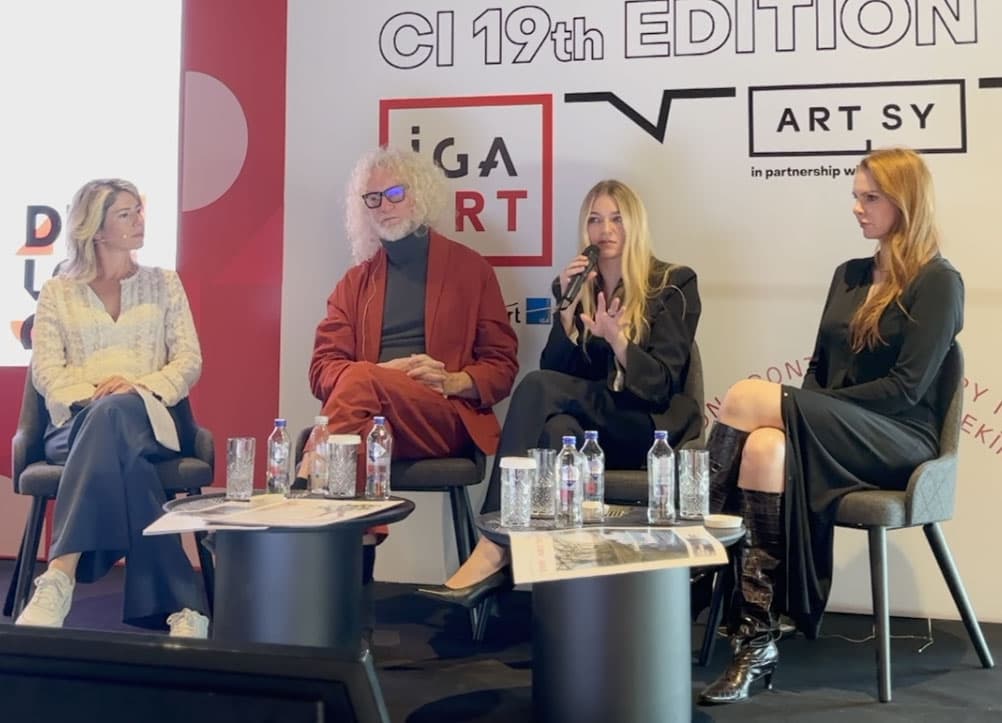
CIF Dialogues: How To Own & Exhibit Digital Art Today?
A panel talk with the participation of TAEX Head of Development which took place at the 19th edition of Contemporary Istanbul art fair on October 23.
<h3 dir="ltr">CIF Dialogues by İGA Art in partnership with Artsy reopened in the framework of the 19th edition of Contemporary Istanbul. This annual series of panel talks focuses on the changing landscape of contemporary art through a variety of perspectives, the social and public impacts of art collecting, and digital art in the age of AI.</h3> <p dir="ltr">TAEX Director of Development Stefanie de Regel was eager to participate in the CIF Dialogues panel talk “How To Own & Exhibit Digital Art Today?” moderated by Digital Sales Strategist Sureyya Wille with Founder and Director of bitforms gallery Steven Sacks, and Art + Tech Consultant and Director of Sales at Feral File Lauren Jones. An intensive conversation touched on the dynamics of the changing art market, the emergence of a new generation of collectors and the rise of new features specifically related to digital art collecting. A panoramic view from players in the digital art market with various backgrounds gave a stimulating picture of this doman’s future.</p> <p dir="ltr"><strong>Sureyya Wille: The first use of the term 'digital art' was formed in the early 1980s, when computer engineers devised a programme which was used by the pioneering digital artist Harold Cohen. So the point is that digital art has a long and I think much overlooked history if you put it in the canon of the history of art. And here we are today, where it is increasingly accessible in this contemporary moment, there are infinite ways and also more affordable ways to own digital art and to present it in your home. Knowing all that, can you tell the audience and myself what are the advantages to collecting digital art versus traditional art? </strong></p> <p dir="ltr"><strong>Steven Sacks:</strong> I think that digital art, it is really what someone is interested in, but if they do want to purchase these I’d say ‘new media artworks’, as I prefer this term more than the TATE’s definition mentioned previously. When we speak of digital it’s really almost everything, a tool that's being utilised for so many things. ‘New media’ is a way of producing in an experimental way, which of course uses modern technology.</p> <p dir="ltr">I started bitforms gallery 23 years ago. Back then I would have answered differently to the same question. But today its accessibility is incredible, the amount of people who have a better understanding of what ‘new media’ is, and how to collect this type of work has grown dramatically. This sounds trite or simple, but even the equipment that is utilised today is much more affordable and way better quality and it lets people showcase works much easier now. Actually it is letting artists create work more affordably, which is in fact a big deal.</p> <p dir="ltr"><strong>Stefanie de Regel:</strong> The dialogue that I often encounter with collectors is that, of course, people want something tangible, right? They are used to collecting something that they can physically see or feel by placing their house and the digital is a bit different. Indeed, the development, the quality and accessibility of software is increasing. Around a year ago I had a conversation with a collector who said to me "I'm not interested in this kind of art". When I asked "Why not?", he replied "I don't really understand this. And I cannot hang it in my house".</p> <p dir="ltr">Then I started to explain that it is the contrary, you can hang a digital artwork basically everywhere you go and always have it with you, whether it is your summer house or your residence. It is extremely easy to transport, the taxation is different. It is important to understand all these advantages. What I see, is that there is an obvious need for communication and education. That’s why at TAEX we are investing a lot in dinners and panel talks. Even participating in art fairs might be challenging for us, for instance it was quite tricky last year to join Contemporary Istanbul. I’ve heard that ‘in Turkey people are not interested in digital’, but what I see this year even after one day of work is quite the opposite. People are very curious, they collect. We’re very happy that the dynamics are changing.</p> <p dir="ltr"><strong>Lauren Jones:</strong> Everybody collects for different reasons. And one of the reasons is indeed an investment. In my perspective, there is a better and exciting opportunity to collect and see an increase in value. Since media art has been so undervalued for so long, all other paradigms shift, our next Gen-Z collectors are younger, they are about to inherit a great amount of wealth. They are more likely to appreciate the value of digital media and disrupt the top level of media where we see canvas and sculpture. This is exciting, as it makes the market more accessible for younger collectors. </p> <p dir="ltr">There's been a lot of talk about how auction sales are down about 20% to 25%. But at the same time in 2024, prints and multiples are up, as younger collectors become more obsessive about them.</p> <p dir="ltr"><strong>Sureyya Wille: Taking it from the accessible pricing, we cannot not talk about NFTs and their insane rise and fall. Do you treat NFTs as distinct from the rest of ‘new media’ or ‘digital art’ or are they a part of it? </strong></p> <p dir="ltr"><strong>Steven Sacks:</strong> For my gallery that emerged way before NFTs it was incredibly disruptive and stressful. This was a completely new community that was not really part of the traditional art world which my gallery and I personally was part of.</p> <p dir="ltr">We tried and succeeded, however it took a long time to integrate this type of work into the mainstream contemporary art world. Of course the Beeple sale of $70 million attracted a lot of attention. The art world woke up and started to get involved. For me in the beginning it was challenging because I don't think that at first the audience was looking at those works as art, it was more of a financial asset and a certain way to legitimise crypto. And many of those works were not art at all. And the big thing, which maybe we'll get into, was that the presentation was completely discarded, which is a huge part of experiencing art. </p> <p dir="ltr">But on the positive side, the market did grow for 4-5%, which is a big deal. Of course, we're in a different moment where the market has somewhat crashed. Now, there are more thoughtful and interesting projects being made, than when NFTs actually started.</p> <p dir="ltr"><strong>Lauren Jones:</strong> Well, I've worked with different collectors and in the traditional gallery. I had to onboard people to use MetaMask and that was impossible. I did not have success with it, but I'm always interested in talking to traditional art collectors and asking them what they think about this media. </p> <p dir="ltr">I always start with art itself. Area Harvey is a pioneer in digital sculpture and 3D modelling, and her practice is very much within the tradition of sculpture. So for her NFT is just a media, and each of her pieces has a certificate of authenticity. </p> <p dir="ltr">Recently, the ArtNews Top 200 Collectors list came out and I did outreach to a bunch of them. I tried to get in touch with collectors of contemporary art, especially when they were investors in technology, or who worked in technologies. I reached out to at least 40 of them, and I ended up with five people that got back to me, and I’ve sent them a presentation or set up a meeting.</p> <p dir="ltr">I have a feeling that after the bubble and then the crash of the NFT market and the crypto market, that followed up with negativity, that now the dust is settled. A lot of banks are now offering ETF for cryptocurrency. And people started to come back and ask: What’s happening over there? It’s a time for some optimism and more thoughtful interest.</p> <p dir="ltr"><strong>Sureyya Wille: I'm curious about the overlap or lack of our collectors. Who are they? Who are the people buying digital art versus traditional art? Are they a completely different distinct group of aficionados, or are they kind of one and the same? Are there trends that you see from traditional art collecting that are similar to digital art collecting?</strong></p> <p dir="ltr"><strong>Stefanie de Regel:</strong> At TAEX we are onboarding a lot of traditional art collectors towards digital art. We don't even like to make that distinction: it is all contemporary art. And it's just a different way of collecting, receiving it, and having it at your place.</p> <p dir="ltr">NFT is a word that scares a lot of people away, but essentially it is a vehicle. It is a smart contract—the most contemporary way to actually possess a digital piece of art. But if you're not familiar with how to create a crypto wallet, then, of course, it can scare people away. I think, a very important mission for galleries, platforms, and art advisors is to guide collectors through that journey, which is actually not that complicated as it may seem. And once you get a hold of it, you'll find it very enjoyable and want to collect more. I see a lot of people from the tech industry, like tech entrepreneurs, traditional collectors.</p> <p dir="ltr">Three weeks ago when we had an event in Geneva a big Swiss collector who is around 75 y.o. approached me and said “I love this piece”. It was a work by our artist MAOTIK. He was mesmerised and asked “How can I collect this?”. So what we do at TAEX, we create a room to have this kind of dialogue. It just has to be the right format, right space, right artworks and artists, and magic will happen.</p> <p dir="ltr"><strong>Sureyya Wille: Steven, since your gallery has been around for 23 years. When I think of a traditional art collector as someone who just ‘has to have it’ and they keep buying more and they are running out of space and pass their collections in storage. Do you see a similar enthusiasm and zeal in the digital art/new media collectors?</strong></p> <p dir="ltr"><strong>Steven Sacks:</strong> If you come to my stand at Contemporary Istanbul, you could see it's not always a moving image. It is not always plugged in. I am a big supporter of artists utilising new technologies but actually creating very traditional formats. Not just because the artist is doing it. I think it is nice to have that diversity in the programme and to offer collectors different ways of participating in this new type of work.</p> <p dir="ltr">One of the most interesting things over the years, which kind of relates to all of us on the panel is that having the screen in your home devoted to art was a very, very new concept when I started. Once collectors understand that conceptually it is incredible, because I have very wealthy collectors and their apartments can only be so big, right. And a lot of them become very upset about putting artworks in storage and not having an opportunity to live with it. So works that are screen-based in many cases you could have 10/20/30 pieces in a single screen and be your own curator of that work. </p> <p dir="ltr">And that is the pinnacle moment for these collectors, once they figured that out. They don't have to deal with moving work. They just have to have the hardware like a screen. It has been a really interesting shift that I saw and once the collector gets this idea.</p> <p dir="ltr"><strong>Sureyya Wille:</strong> <strong>What do you recommend to your collectors in terms of how to install the work, how to live with the digital art collection and enjoy the works? Shall one have screens up all over your house? Do you carry around your phone? </strong></p> <p dir="ltr"><strong>Lauren Jones: </strong>The fact that most people now have a digital canvas in their home, in a television smart TV is also a game changer. We are not far from the moment when people would say “gosh, you can't believe we just have these black boxes, these black culture boxes”.</p> <blockquote> <p dir="ltr">We all saw a little test case with the Samsung frame and the popularity of the Art Store, but those are high resolution photographs of Old Masters works, and as it looks for me just like elitist posters. The theorist and philosopher Walter Benjamin talked about the aura of art and the way that it's lost when it's mechanically reproduced. But digital art, that file based art, is digitally needed. </p> </blockquote> <p dir="ltr">Most collectors take into account the aesthetics of what they are, you know, they want something that would look nice in their interior. The ability to live with that kind of work is their opportunity to change it over with our app. You can make playlists and set up the time for them, for example for a dinner party. I think that a smart TV is a great starting point to start living with digital art. </p> <p dir="ltr"><strong>Stefanie de Regel:</strong> There's also the psychological element and the power of habit. For most people TV is used as a medium for watching news, movies, and entertainment. A sudden switch to use it as a canvas, it requires some time. There are also really nice frame solutions like digital frames. When last week collector Hélène Nguyen-Ban opened up her house during Art Basel Paris, I spotted a beautiful frame that was 2-3 metres high. It didn't look like a TV.</p> <p dir="ltr"><strong>Steven Sacks: </strong>I can't force this situation, but what I suggest to collectors is to have a devoted screen to art because it changes everything. Once that destination is about art versus you flipping to a football game. One very ridiculously simple way to achieve that is to make the screen vertical. Where they'd be having some trouble watching TV. And not all works of course are in that portrait landscape, but actually it's a lot are. And in my home, for example, I have one landscape, one portrait. They're only devoted to art. </p> <p dir="ltr">And once again collectors experienced this and they understand the ease of doing it; they won't want to watch television and will feel that connection to the screen as an art experience.</p>
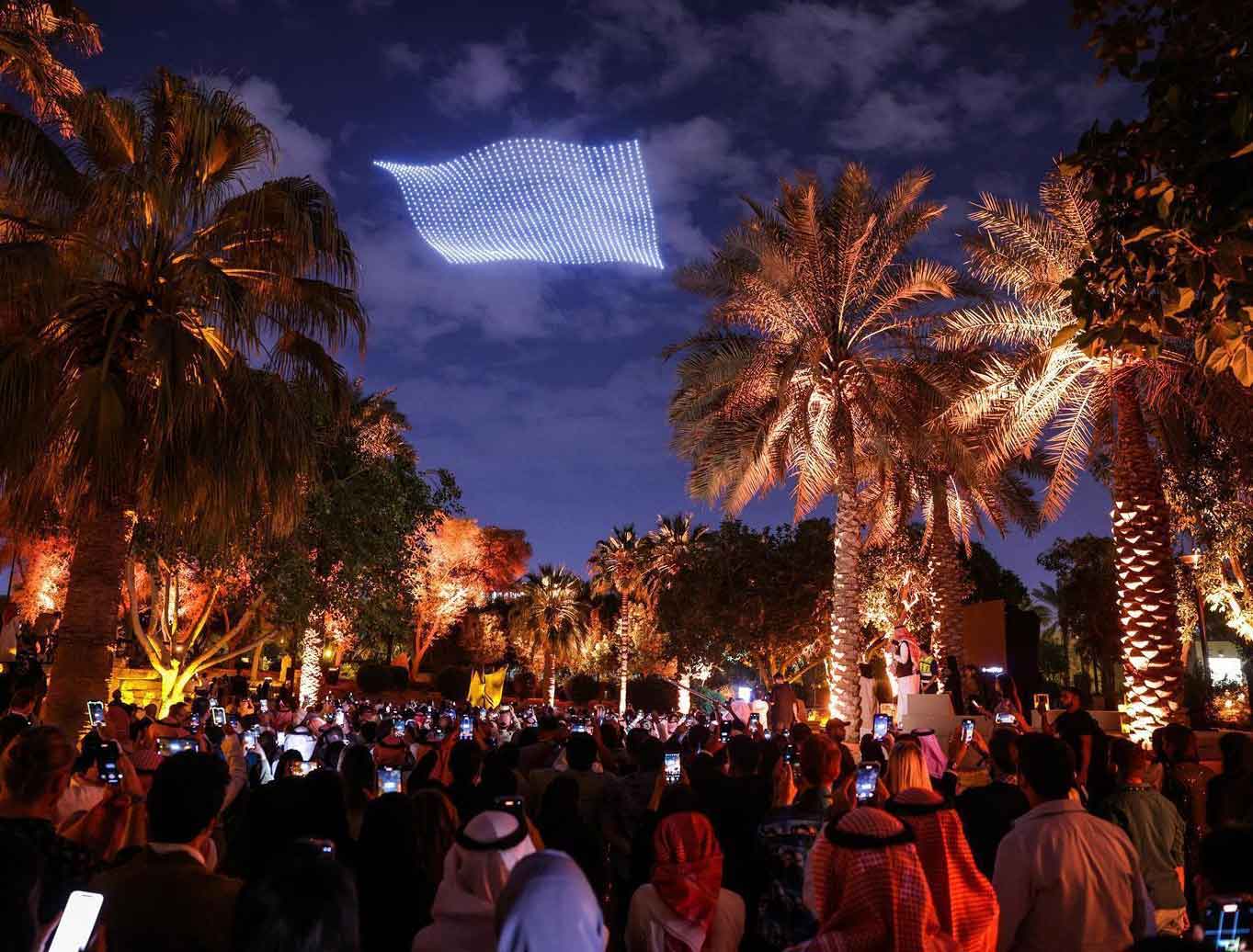
Stars are the limit at Noor Festival in Saudi Arabia
At the end of November, TAEX team personally witnessed the groundbreaking opening of the 4th edition of Noor Festival, the world’s largest light art festival, in the framework of Ryadh Art.
<h3 dir="ltr">Curated by Dr Effat Abdullah Fadag, Dr Alfredo Cramerotti and Auronda Scalera the festival highlighted the connection between Althara (the earth) and Althuraya (the stars). Featuring more than 60 large-scale artworks, Noor Festival celebrates the power of creativity and ambition in bridging vast distances, both literal and metaphorical. A key part of the fundamental Saudi Vision 2030 program, the festival will highlight both 18 Saudi artists and 43 international artists. </h3> <p dir="ltr"><img src="https://cdn72109500.ahacdn.me/news/upload-815524838.jpg" alt="Heart Space, Krista Kim" width="1500" height="826"></p> <p dir="ltr"><span class="custom-span">Krista Kim, Heart Space: 3256, Available on request</span></p> <p dir="ltr">The Noor festival transformed the Kingdom’s capital into a gallery without walls and intertwined life, art and technologies across Ryadh’s major centres of gravity—the King Abdulaziz Historical Center, Wadi Hanifah district with long pedestrian paths, rest zones and the industrial JAX District. Using light as the main medium, most of the works are digitally-driven whether it is an immersive experience, projection mapping, or an installation. The program featured 62 light-based artworks, including Heart Space, the world's first biometric AI installation by Krista Kim; Spark a magical cloud of biodegradable light sparks inspired by fireflies and stars by Daan Roosegaarde; Aether, a 1500 drone show by British collective United Visual Artists.</p> <p dir="ltr"><img src="https://cdn72109500.ahacdn.me/news/upload-4121783010.jpg" alt="Nick Verstand, Aura, 2017" width="800" height="491"></p> <p dir="ltr">Nick Verstand, Aura, (2017), image: riyadhart.sa</p> <p dir="ltr">In order to grasp the intense programme, the festival <a href="https://riyadhart.sa/en/noor-riyadh/festival-trails/">suggests</a> various paths from 3 hours to a 7-hour ‘Marathon of Light’. The artworks are supported by a public programme, including workshops, panel talks, and performances.</p> <p dir="ltr">Former cultural capital of the Arab world according to UNESCO, Riyadh is now the heart of the global transformations of the cultural sector. Over the last years, Saudi Arabia <a href="https://hbr.org/sponsored/2024/08/the-vibrant-culture-of-saudi-arabia-today">made</a> unprecedented investments and efforts in the cultural sector supported by socio-economic reforms in the country. With <a href="https://www.christies.com/en/events/christies-middle-east/about">an expansion</a> of Christie’s to the Kingdom in the past September Saudi Arabia became an important art player not only in the region but worldwide.</p> <p dir="ltr">The Noor festival is open to public until December 14th, take your chance to see it.</p> <p> </p>
Stay Tuned
Be the first to learn about new collections, events, and more.