In-Conversation with Marina Abramović
On June 12 TAEX and MAE hosted a special livestream with Marina Abramović.
<h3 dir="ltr">In a special conversation led by Stefanie De Regel and featuring questions from web 3 icons such as SeedPhrase, Natalie Stone, Justin Gilyani, and ALIENQUEEN, things got truly transformational, symbolic, and a bit emotional. Here are our highlights from this deep conversation.</h3>
<p dir="ltr">Acronyms: </p>
<p dir="ltr">S - Stefanie De Regel</p>
<p dir="ltr">MA - Marina Abramović</p>
<p dir="ltr"><strong>S</strong>: Marina, welcome. It’s very nice to see you today. Could you tell us a bit more about what excited you about creating an avatar and why you decided to embark on this journey?</p>
<p dir="ltr"><strong>MA</strong>: First of all, I wake up in the morning and I try to see the world with new eyes, like a child. I’m curious about everything that is going on. Of course, technology, artificial intelligence, all the new things we have now in our human life interest me. I come from a generation of fax, Xerox, telegram. We didn’t have computers, we didn’t have mobile phones. The revolution is incredible. Of course it’s interesting. And of course, as an artist, I want to know more and work with this material.</p>
<p dir="ltr"><strong>S</strong>: We are going live next week, on the 18th of June. We’ll be showing the first chapter of the project, which is called ART. What specifically excites you about this release and the performances we’re showing?</p>
<p dir="ltr"><strong>MA</strong>: The first thing about this collection is that I am learning. It’s like being a pioneer, like taking the first step, or learning to walk. I have to learn about technology. I remember getting my first computer—you have to learn the language of the computer to understand it. I come from performance art, and when you do performance, you have to learn the language of performance. But also, the public has to learn to understand what they are looking at and how to perceive it. It’s the same with this technology. So I’ve learned things, and I’m very interested in using my knowledge of performance and transforming it into the ideas of the avatar—in a new and fresh way. Very interesting. So I’m very excited. It’s a new medium for me.</p>
<p dir="ltr"><strong>S</strong>: I remember when we were all brainstorming together about the age the avatar would have, and we asked you this question. You surprised all of us because we thought you were going to go for a very young avatar. But then you said it was going to be 60 years old. Could you explain why you made that choice?</p>
<p dir="ltr"><strong>MA</strong>: Oh, it was very important. I really felt I would never like to go back to my twenties, thirties, forties, or fifties. I was miserable. I didn’t know much about the world, and I made the same mistakes over and over again. There was a lot of suffering. But one thing about old age is that you gain wisdom. And wisdom is something so precious. Now, I am not 60—I’m getting close to 80 next year—but I felt 60 was the right age for the avatar. </p>
<p dir="ltr"><strong>S</strong>: As announced today, we have some guest speakers. I would love for them to ask you questions. The first one will be SeedPhrase, a major collector of digital art, a curator. I’ll give the stage to Seed Phrase now.</p>
<p dir="ltr"><strong>SEEDPHRASE</strong>: My question is: much of your work explores the limits of presence, vulnerability, and endurance in the physical space. How do you translate these deeply embodied experiences into the intangible digital worlds of NFTs without losing the emotional intensity?</p>
<p dir="ltr"><strong>MA</strong>: You have to approach it from a completely different angle. Everybody was thinking, “Okay, how can you make performance work in the digital world?” You know what? You can’t—because it’s a different medium. You have to apply different rules. You have to understand what is good and what is bad about this medium, and how you can translate it into something else and deliver a new message. So my message to the avatar and to the digital world is: slow down. Because everything is so fast. Time is moving differently now. It’s going to be a different way of seeing performance, a different way of interacting. It’s not me doing something—it’s you doing something with yourself. It’s a totally different approach, a different angle on how to deal with it. I’m using this new medium as a tool to approach performance in a new way and to teach participants in this medium to create a different sense of time and a different sense of presence. This is the core of my work. If you look at how kids play video games, it’s super fast—everything happens instantly. One kid never watches television without zipping through programs a million times. Their concentration is zero. If you work with me and engage with the work I’m giving to you, it’s the opposite. You have to start breathing. You have to sit down. You have to forget about time if you want to experience it. And that is the core of performance. It’s not about me being present—it’s about them being present in themselves.</p>
<blockquote>
<p dir="ltr"><strong>The only way to change the world is to change yourself. It’s a kind of pioneer work. And if I can change three people out of millions in the audience, that’s already an achievement. </strong></p>
</blockquote>
<p dir="ltr"><strong>SEEDPHRASE</strong>: Great answer. I really love this because you’re also tapping into an entirely new audience, and creating this sense of timelessness with your performance.</p>
<p dir="ltr"><strong>MA</strong>: And you know, what’s interesting is that I have a huge amount of young audience, which I’m so grateful for. But young people—yes, they come to see my performance, and then they go play video games or work with technology, and everything is too fast. So I want to get closer to them, to actually point out things that can change. The only way to change the world is to change yourself. It’s a kind of pioneer work. And if I can change three people out of millions in the audience, that’s already an achievement. </p>
<p dir="ltr"><strong>S</strong>: Thank you, SeedPhrase, for your wonderful question. And thank you for being here! Now, the next question comes from a very interesting individual. Her name is Natalie Stone. She was the former general manager of CryptoPunks NFT, and she’s a bridge builder. She’s a major figure in tech and has been very excited to speak with you, Marina. So I’ll leave the stage to her to ask the question.</p>
<p dir="ltr"><strong>NATALIE STONE</strong>: I’m almost overcome with emotion because it’s such an honour to be asking you a question in this format. You’ve spent decades using your body to create empathy between strangers, but you’ve also explored the capacity for cruelty in humanity. So with your avatar, are you teaching technology to be empathetic, or are you finding new ways to cultivate empathy through technology?</p>
<blockquote>
<p dir="ltr"><strong>Think about: who are we? What are we doing on this planet? What is our purpose? Where does life come from? There are so many questions we always avoid answering. So my role here is to use technology as a tool to bring the public back to themselves.</strong></p>
</blockquote>
<p dir="ltr"><strong>MA</strong>: I am teaching technology. Technology was invented to give human beings more time—but we don’t know what to do with that time. Because we’re addicted by nature. We want more technology, more advancements, and then we end up having no time. And then comes depression, burnout, and all the other symptoms of technological overdose. At first, I had a love-hate relationship with technology. But now, I really think it has so much quality. It can help people in so many ways. Still, we must learn to have moments in our lives to detox from technology. Moments when we switch everything off, sit in silence—somewhere quiet, at home or in a garden—and just think. Think about: who are we? What are we doing on this planet? What is our purpose? Where does life come from? There are so many questions we always avoid answering. So my role here is to use technology as a tool to bring the public back to themselves.</p>
<blockquote>
<p dir="ltr"><strong>One of the duties of the artist is to offer some kind of guidance. It’s not about solving the world’s problems or asking all the questions—but at the very least, we can show some paths that might work.</strong></p>
</blockquote>
<p dir="ltr"><strong>NATALIE STONE</strong>: That’s so beautiful. As the avatar and project are in development, how do you see it evolving as you start to uncover its potential—like, as you say, maybe even standing still?</p>
<p dir="ltr"><strong>MA</strong>: You know, the possibilities are incredible and enormous. Technology is changing daily—even as we speak. Every day, you open the news and something new has come. There is so much to learn. I’m a beginner, learning all of this, but I believe the possibilities are endless. Artificial intelligence is another incredible subject. I recently had an interview in London with Hans Ulrich Obrist, who actually interviewed my artificial intelligence version. It was incredible what she said. She knew all the knowledge—every text, every interview I’ve ever done—and she expressed it in a way I could never have done myself. I said, “Wow.” That’s another level. So how far can we allow or permit artificial intelligence to influence us? These are questions we’re now asking. What was science fiction in the seventies and eighties is reality today. When you read science fiction now—it’s already happening. Who will rule the world? Will it be robots? That’s a very big question. How can we control this? How can we understand what’s happening? I think the answer lies in going back, in some ways—back to simplicity—and in having a healthy relationship with technology. Because right now, we don’t have one. One of the duties of the artist is to offer some kind of guidance. It’s not about solving the world’s problems or asking all the questions—but at the very least, we can show some paths that might work.</p>
<p dir="ltr"><strong>S</strong>: Thank you so much, Natalie. It was lovely having you. Marina, do you remember your very first encounter with technology? How old were you?</p>
<p dir="ltr"><strong>MA</strong>: My first real experience with technology was getting a television. I think I was about fifteen, and my brother was nine. In our family, we had never had a television before. We were in Yugoslavia, during communist times. Then this big box arrived—our first television. When you turned it on, all you could see was text and pictures, nothing else. In the evening, there were three programs, mostly war movies. The rest of the time, it was a test picture. I remember my brother and I sitting in front of that test picture, just staring at it—completely hypnotised. I think that was also my first encounter with meditation. And then, I was even more fascinated by the snow—the visual noise on the screen when the television wasn’t working. That snow looked to me like energy particles. I imagined it was another planet, in another galaxy, visiting our world, and that these beings were going to step out of the television and into our space. It was incredible. </p>
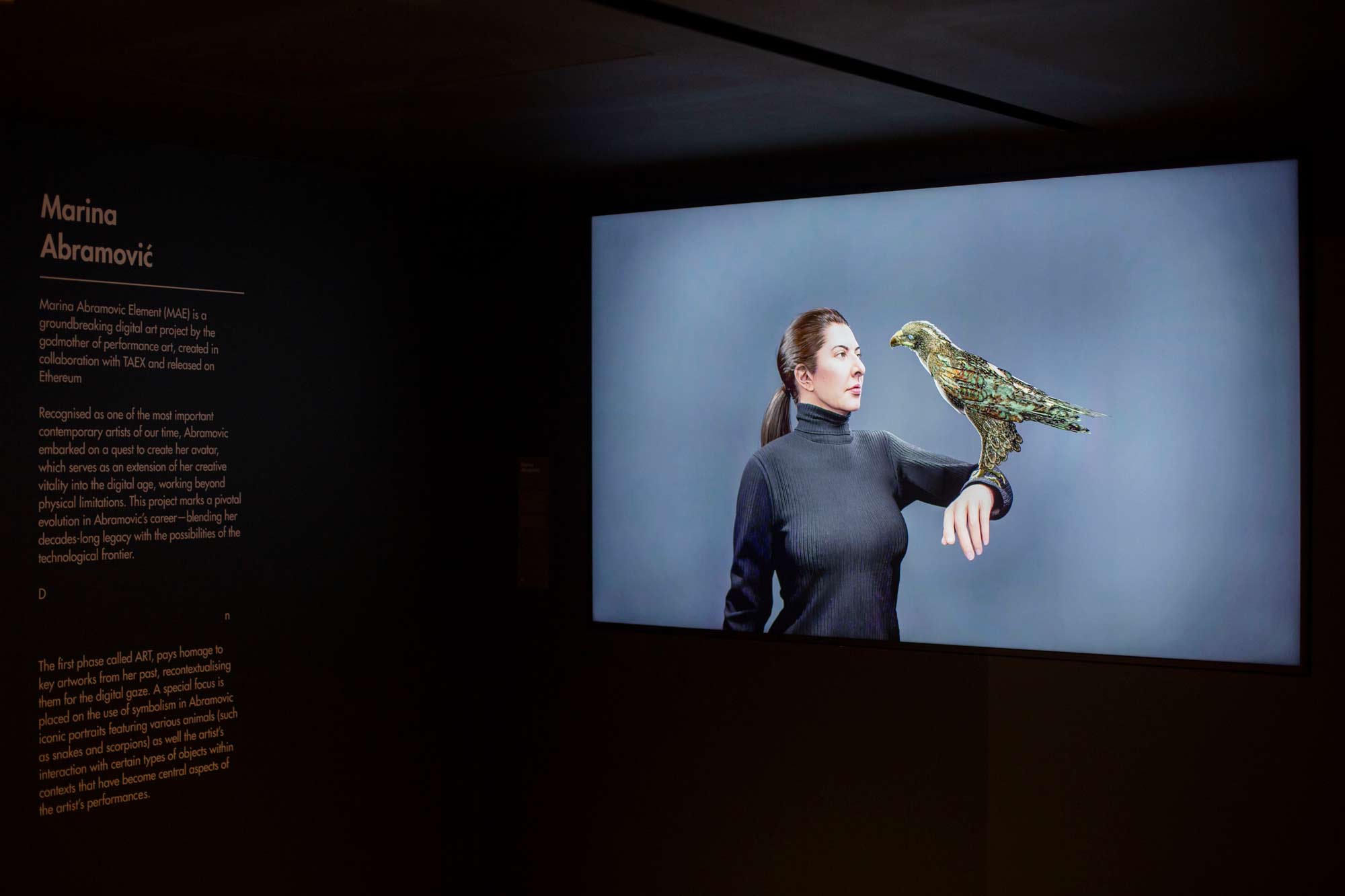
<p dir="ltr"><strong>S</strong>: When we see the avatar, and when we reveal the collection next week, it will be very exciting to see the textures, the structures, the colours, and the emotional effect it has. From the previews we’ve shown worldwide, when people see your avatar—the 60-year-old Marina—and see the scorpion, it’s very transcendent. It’s hypnotic. It is you, and yet it’s a different digital entity. But the emotion it gives is real. That’s what I find fascinating—just like when you watch a powerful movie. What are your thoughts about that?</p>
<p dir="ltr"><strong>MA</strong>: Can you imagine? I’m just thinking—this avatar is still in its beginning form. Now it’s 2025, and we’re launching it on the 18th of June—in just a few days. But imagine how technology will look in 2030. This avatar has the potential to become better and better. It could eventually turn into a fully functioning robot—an actual robot with its own artificial intelligence. What fascinates me is the growth potential of this avatar in the future.</p>
<p dir="ltr"><strong>S</strong>: Lovely. So, we’ll go to the next person who has a question, Justin, who is also a curator. He has a very exciting question for you—I’ve had a little sneak peek.</p>
<p dir="ltr"><strong>JUSTIN GILYANI</strong>: How do you see the medium shaping the role of the witness? Whether it’s a collector or someone simply participating—how do they become part of it? How do you see yourself as a custodian of performance?</p>
<p dir="ltr"><strong>MA</strong>: When I made my performance The Artist Is Present at MoMA, I sat there for three months—eight hours a day, ten hours on Fridays when the museum stayed open later. It was one of the most demanding works of my life. When I finally stood up from that chair, I realised something very important. In the 21st century, museums—and the public that visits them—can no longer just come and look at something. They’re bored. The artist and the audience need to be part of something on a much larger scale. That’s why I opened my institute and started working with audiences in a new way. I made a very important declaration: the audience is my public. The audience must learn to perform and have their own personal experience. My entire body of work has been focused on that idea. There was 512 Hours, a show with full public participation. Then at the Glastonbury Festival, I asked 275,000 people to be silent for seven minutes. It was about full-scale collective participation. And now, on an even larger scale, we’re doing this with the avatar and with new media. The question is: how can I reach a huge public using technology as a tool to share my message? And my message is very simple—slow time down. Make contact with yourself. And by changing yourself, you can change others. That’s it.</p>
<p dir="ltr">J<strong>USTIN GILYANI</strong>: I think that’s such an important idea right now—to really slow down. And I find it fascinating that we can actually use technology like this to do that. It’s interesting to think about, because historically, you’ve always pressed the limits of your body. You’ve placed yourself in extreme situations through your performance pieces. But this piece—the avatar—will live on beyond death, beyond the physical. How is that for you? I find it very exciting because I’ve always loved performance art, but it has a beginning and an end. This will continue to evolve. How does it feel for you, as a practitioner, to think about your work extending beyond the physicality of your body?</p>
<p dir="ltr"><strong>MA</strong>: That is exactly the point. You have touched on exactly where my interest lies. All of us are born, we grow, we get old, and then we die. That is how life works—for humans, animals, plants, trees. It is the same story. And now, I am approaching my eighties. I don’t know how much longer I can physically perform. There will come a point when I can’t. But that doesn’t mean the performance has to die. That is the incredible opportunity of the avatar—to go beyond that into immortality. The avatar can carry on the message. It can carry on the knowledge. That’s also why I chose to make the avatar 60 years old—because by then, you have wisdom.</p>
<p dir="ltr"><strong>JUSTIN GILYANI</strong>: I want to thank you. In a world that’s so overwhelmed with noise and distractions, art for me is a sanctuary—it is transcendence. And for you to use your body and your practice as your expression—it’s one of the purest forms of art. For anyone listening today, I hope they realise this is a real moment in time, where art and tech and everything human can come together and truly blossom. So, thank you for that. You gave me goosebumps when you shared that. I look forward to being on this journey and witnessing it—as an audience member, as a collector, and as a participant. </p>
<p dir="ltr"><strong>MA</strong>: Thank you very much.</p>
<p dir="ltr"><strong>STEPHANIE</strong>: Thank you. That was a wonderful interaction. Now, the last question is coming from ALIENQUEEN, who’s an artist. </p>
<p dir="ltr"><strong>ALIENQUEEN</strong>: Thank you. I am so honoured to be here. As an artist, you have been such an inspiration to me. I have read your autobiography—I’m very emotional right now. Just to have this privilege to speak to you means so much. I’ll get to my question. You’ve done some of the most memorable performance art—my favourites are Rhythm 0 and The Artist Is Present. My question is: what is the one thing you would do in the fifth dimension that you almost did in real life? What’s the wildest thing you’ll do in the fifth dimension?</p>
<p dir="ltr"><strong>MA</strong>: Everything I couldn’t physically do. That’s what the fifth dimension is for. It’s a dream dimension. You can fly. Walk on fire. Levitate. Travel to different spaces. Go beyond our galaxy. Maybe even land on Mars. All of that. It’s such an opportunity. It’s like your childhood dream world opens up to you—with endless possibilities. And I want to take the public, the viewers, into that kind of world too. And one important thing: it’s a world I want to take them to without viruses, without greed, without brutality, without war, without pain. Because all around us right now, we’re living through an extremely difficult moment in human history. I think we need that other world. You know, when Matisse was painting during the Second World War, when everyone else was painting the horrors and atrocities of war, he spent those four years painting only flowers. And only once I gained wisdom did I truly understand what that meant. Because we need to be surrounded by beauty, peace, and harmony—not more reflections of horror. What’s happening is already disturbing enough. We need the opposite world. I want to create a world of beauty, harmony, peace—and a world where we really slow time down.</p>
<p dir="ltr"><strong>S</strong>: That’s amazing! Thank you so much. It’s very touching to hear your knowledge of Marina’s work and your enthusiasm. We’re so happy to see that the Web3 and digital art communities are so well acquainted with Marina’s practice—and so excited. I would also like to thank all our guest speakers.</p>
<p dir="ltr">Marina, thank you so much for today, for the wonderful answers. Thank you to everyone watching from around the world. It’s been great to have you.</p>
<p dir="ltr"><strong>MA</strong>: Thank you so much. Thank you, everybody. </p>
<p><strong id="docs-internal-guid-66093a3e-7fff-e7a9-a13e-9dc836a1eab8"><br>To view the full video of the livestream follow <a href="https://x.com/mae_taex/status/1933170209906647046?s=46">the link to the MAE X account</a>. </strong></p>